
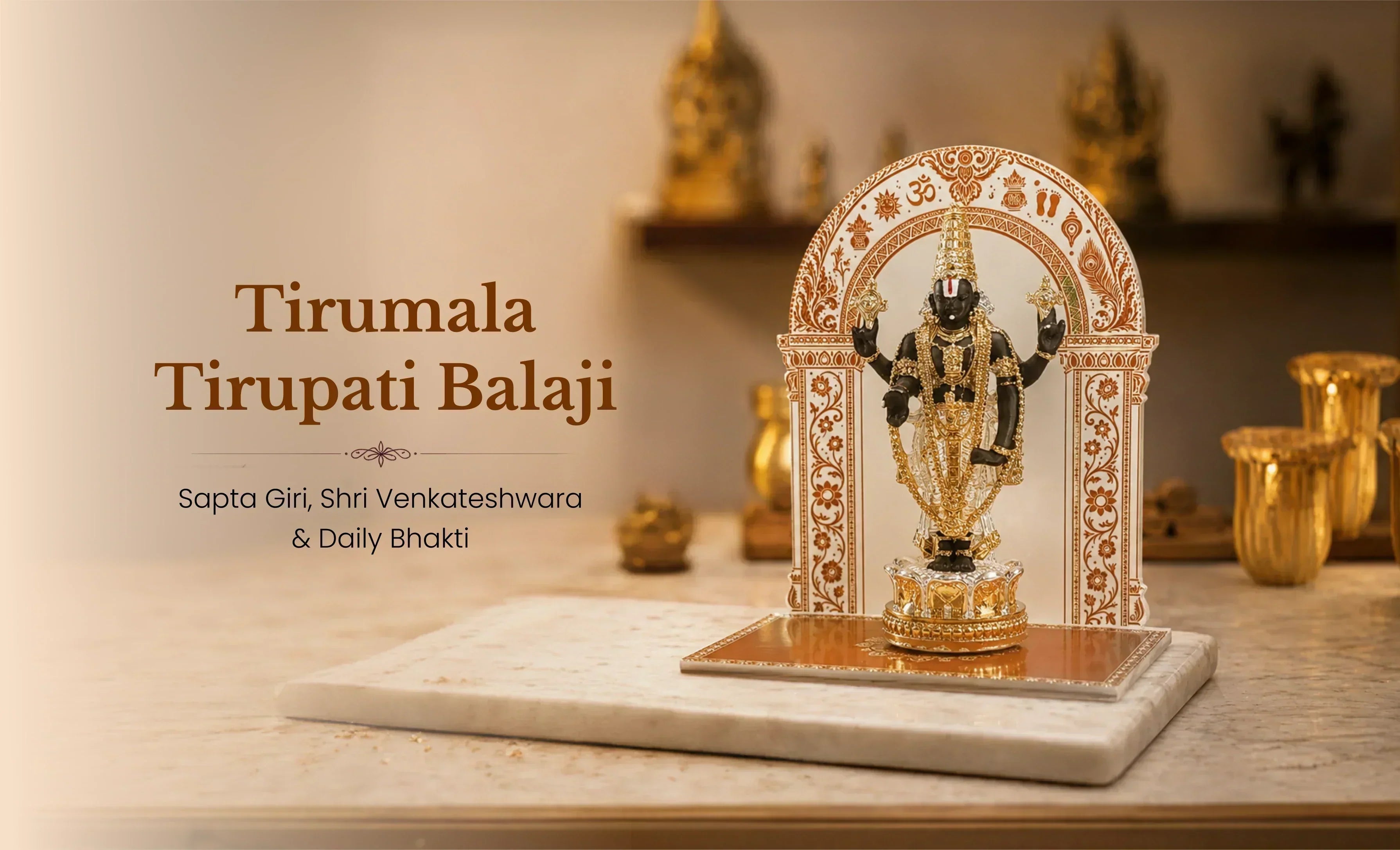
📍 Quick Facts — Tirumala Tirupati Balaji
| Deity | Shri Venkateshwara (also called Balaji, Govinda, Srinivasa) — Kaliyuga avatara of Bhagavan Vishnu |
| Location | Tirumala, Tirupati district, Andhra Pradesh, India |
| Hill Range | Seshachalam (Sapta Giri — the seven sacred hills) |
| Tradition | Sri Vaishnava |
| Managed By | Tirumala Tirupati Devasthanams (TTD) |
| Daily Pilgrims | 50,000–100,000+ — among the most visited religious sites worldwide |
| Primary Texts | Venkatachala Mahatmyam (Brahma, Skanda, Padma, Bhavishyottara Puranas), Varaha Purana |
| Key Mantra / Chant | Govinda Govinda · Om Namo Venkateshaya |
| Best Time to Visit | September to February (cooler, less crowded outside festivals) |
| Nearest Airport | Tirupati International Airport (~40 km from Tirumala via ghat road) |
High above the plains of southern India, on a range of seven sacred hills, lives the Lord whom millions call simply Govinda. Day and night, the chant rises from His temple courtyard — Govinda Govinda — carrying the prayers of farmers and kings, of children and elders, of seekers who have walked barefoot up the hills and of those who have travelled across oceans to stand before Him.
He is Shri Venkateshwara — the Lord of the Seven Hills, the Kaliyuga avatara of Bhagavan Vishnu Himself. The temple at Tirumala, where He stands in His self-manifested mula-vigraha form, is by tradition the most visited place of worship anywhere on earth.
If you have ever stood in a TTD queue for hours hoping for a few seconds of darshan — or if you have only ever dreamed of making that yatra — this guide is for you. We will walk through who Venkateshwara is, what makes Tirumala unique among all tirths, and how you can keep the rhythm of His daily worship at home.
Who is Shri Venkateshwara?
Shri Venkateshwara is Bhagavan Vishnu Himself, in His Kaliyuga form as the Lord of the Seven Hills.
The shastras describe Him as the deity who has chosen, in this age, to become most accessible to the seeker — taking the form of the self-manifested mula-vigraha at Tirumala, where He has stood for over a thousand years.
What makes Venkateshwara unique among the avataras of Vishnu is His availability. Where Ram and Krishna walked the earth in earlier yugas and returned, Venkateshwara is here, now, in stone — for any devotee, of any caste, from any place, with any history. He has descended into a form so simple and so present that the simplest devotee can come to Him.
This is why the Tirumala temple receives more pilgrims in a single day than most religious sites do in a year. The Lord is accessible. And the devotees come.
What does the name "Venkateshwara" mean?
The acharyas of the Sri Vaishnava tradition unfold the name as follows:
- Vem — sins or karmic burdens
- kata — to cut, to remove
- ishvara — the Lord
Therefore: Venkateshwara is "the Lord who removes the burdens of sin."
This is the popular Sri Vaishnava reading — and it is the reason millions of devotees, having tried every other remedy for the troubles of life, finally make their way to Tirumala. The shastras and the saints have promised that here, at this particular hill, the Lord listens with unusual readiness.
He listens, the tradition says, not because He is partial to this place — but because in this Kaliyuga, this is the form He has chosen to make most accessible. He has descended into stone, into a self-manifested murti that no human hand carved, so that even the simplest devotee can come to Him.
Why is Tirumala called the Sapta Giri?
The hills upon which Venkateshwara dwells are not merely seven peaks of geography. The shastras give each hill a name and a meaning:
- Seshadri — the hill of Adi Shesha, the divine serpent who serves as Bhagavan Vishnu's couch
- Vrishabhadri — the hill of Nandishvara
- Garudadri — the hill of Garuda, Vishnu's mount
- Anjanadri — the hill of Anjana Devi, mother of Hanuman-ji
- Vrishadri — the hill of dharma
- Niladri — the dark blue hill
- Venkatadri — the principal hill, the seat of Venkateshwara Himself
Each hill is therefore a presence — a deity in geographic form. And the entire range, in the Sri Vaishnava reading, is regarded as a single living entity: the body of Adi Shesha Himself, upon which Bhagavan Vishnu has chosen to recline in this age.
When you climb the hills on yatra, the tradition tells you that you are walking upon the Lord's own seat.
The roots in ancient wisdom
The story of Shri Venkateshwara is preserved across multiple shastras of Sanatana Dharma.
The Venkatachala Mahatmyam appears in multiple Puranas, including the Brahma Purana, the Bhavishyottara Purana, the Skanda Purana, and the Padma Purana. Each recounts His manifestation on the seven hills with slight variations in detail.
The Varaha Purana describes how Bhagavan Varaha first ruled this hill, and how Shri Venkateshwara later came to live upon it with His permission — which is why every yatri to Tirumala traditionally first offers darshan to Adi Varaha Swamy at the Swami Pushkarini before approaching the main shrine.
The opening of the Venkatesha Suprabhatam — the dawn prayer recited at Tirumala every morning before the Lord's daily seva — is traditionally attributed to Prativadi Bhayankaram Annan (15th century):
"कौसल्या सुप्रजा राम पूर्वा सन्ध्या प्रवर्तते।
उत्तिष्ठ नरशार्दूल कर्तव्यं दैवमाहिकम्॥""O Rama, blessed son of Kausalya — the eastern dawn is breaking. Arise, O lion among men, your daily divine duties await."
The same verse, sung by Valmiki Maharshi to awaken Bhagavan Shri Ram in the Treta Yuga, now awakens the same Bhagavan — present as Venkateshwara — every morning at Tirumala. The two avataras, the tradition reminds us, are not different.
How to begin Venkateshwara-bhakti at home
Sri Vaishnava bhakti rests upon a few unchanging practices. Here they are, in order of accessibility:
- Govinda Nama Sankirtana — the joyous, repeated chanting of "Govinda Govinda"
- Suprabhata Seva — the morning awakening of the Lord through prescribed verses
- Abhishek — the ritual bathing of the Lord, traditionally performed every Friday at Tirumala
- The Hundi offering — offering a portion of one's earnings in repayment of the divine "debt" that all souls owe to the Lord
The simplest and most powerful daily practice is the chant of Govinda Nama. There is a saying among elders in Tirumala: "Govinda anukune evarikee nashtam ledu" — "no one who calls upon Govinda has ever lost."
Here is your daily practice, in its simplest form:
- Sit before your home puja-sthan each morning.
- Chant "Govinda Govinda" for a few minutes — 108 times on a tulsi mala, if you can.
- Visualise Venkateshwara standing before you. His right hand raised in protection; His left hand pointing to His own feet — the gesture that says: take refuge here, and I will lift you out.
- Offer a single tulsi-patra — physically, or mentally — with sincerity.
That, done with sincerity, is complete worship. Venkateshwara, the shastras assure us, receives the bhavana long before He counts the offerings.
Bringing Tirumala home — the Smart Frame as sahayak
The weekly Friday abhishek at Tirumala — when the mula-vigraha is bathed in milk, curd, honey, sandal paste, and ceremonial waters — is one of the most ancient and unbroken rituals in Sanatana Dharma. To witness it, even once, is the dream of every Sri Vaishnava devotee.
For most devotees, life makes this impossible. Tirumala receives more pilgrims in a day than any other temple on earth, and even with TTD darshan tickets, witnessing the actual abhishek is rare. The heart asks: how do I keep this rhythm at home?
The traditional answer is Manas Puja — the inner worship described in our companion piece on Manas Puja, where Venkateshwara is invoked in the heart's own garbh-griha.
But the beginner faces three real difficulties:
- The form (svarupa) — what exactly is Venkateshwara's standing posture, His four-armed form, His ornaments? Most of us have a vague picture, not the actual shastra-aligned form.
- The procedure (vidhi) — what is the correct sequence of panchamrit-snana, shuddhodaka-snana, vastra-arpana, tulsi-archana, naivedya?
- The mantras (uccharan) — which shlokas accompany each step, and how are they pronounced correctly?
This is where our Shri Tirupati Balaji Portal Frame — 3D AR Edition serves as a complete sahayak to ancient practice.
The frame reveals Venkateshwara in His shastra-aligned standing form — the same kala-svarupa as enshrined at Tirumala. The AR portal walks you through the prescribed abhishek vidhi in proper sequence, with the prescribed mantras — Suprabhatam, Govinda Nama, the abhishek shlokas — chanted in correct Sanskrit pronunciation.
The form, the procedure, and the sound enter the mind together. Close your eyes, and all three arise within. Sri Vaishnava bhakti finds its inner foundation.
Aaj Ka Darshan — the home shrine meets Tirumala in real time
This is the section where the bridge between home and tirth becomes most striking. For Tirumala — more than perhaps any other tirth in India — the gap between yearning and access has been widest.
Generations of devotees have prayed for a single Tirumala darshan and never received one in their lifetime. Even today, with all the systems and bookings of the TTD, a yatri may travel for days and stand in queues for hours to receive a darshan that lasts seconds.
A Shri Tirupati Balaji Smart Frame placed in the home puja-sthan changes this rhythm completely.
The AR darshan fixes Venkateshwara's form in mind. The guided vidhi walks you through daily abhishek. The prescribed mantras are chanted in correct pronunciation. And finally, the Aaj Ka Darshan — the live image from the actual Tirumala garbh-griha that very morning — joins your home shrine to the Lord's own seat.
The seven hills and your puja-sthan are no longer separated by distance. They are joined in real time, every single day.
How to reach Tirumala Tirupati
If you are planning a yatra, here is the essential information.
- By Air: Tirupati International Airport is approximately 40 km from Tirumala via the ghat road. Direct flights connect from Hyderabad, Bengaluru, Chennai, Delhi, Mumbai, and select international destinations.
- By Rail: Tirupati railway station is about 26 km from Tirumala and is well-connected to all major South Indian cities. From the station, TTD buses and taxis go up the hill.
- By Road: Two routes lead from Tirupati town up to Tirumala — the older Alipiri Mettu (foot path with steps for those undertaking the traditional walking yatra) and the modern ghat road. APSRTC buses operate frequently.
- TTD Darshan Booking: Online booking is essential for darshan tickets, especially for Special Entry Darshan (Sigh raseed). Book on the official TTD website well in advance. Free darshan is available via the Sarva Darshanam queue but involves longer waits.
- Best Season: September to February is most pleasant. Avoid the summer months (April–June) on the hill, and check for major festival dates when crowds peak.
- Accommodation: TTD provides accommodation at multiple cottages and guesthouses in Tirumala, ranging from free dormitory beds to paid private rooms. Book through the official TTD portal.
For major festivals — Brahmotsavam (September/October), Vaikuntha Ekadashi (December/January), and Sri Rama Navami (March/April) — Tirumala receives several lakh pilgrims. Plan accordingly.
Featured Smart Frames for Vaishnava Sadhana


The 24k Gold-Plated Idol — for those who want daily abhishek at home
For devotees who wish to perform daily abhishek in the most traditional manner — with their own hands, on a physical murti — our Tirupati Balaji 24k Gold-Plated AR-Powered Idol offers something unique.
The idol is crafted in the authentic kala-svarupa of the Tirumala mula-vigraha, with 24k gold ornaments and 999 silver detailing faithful to the original. It is then paired with a full AR-guided abhishek experience through the Shubh Darshan app — water, milk, tulsi, flowers, each step accompanied by the prescribed Sanskrit mantras in correct pronunciation.
For households that cannot maintain the full physical infrastructure of daily abhishek but want a tactile, traditional daily seva, this idol becomes a complete practice — beautiful enough to keep on the puja-sthan, instructive enough to teach the vidhi, and modern enough to bridge home and Tirumala in one daily ritual.
Teachings of the Saints on Venkateshwara-bhakti
Annamacharya (1408–1503), the great composer of Tirumala, gave Venkateshwara over 32,000 sankirtanas. Songs of love, longing, philosophy, and praise. He sang the Lord into every emotion the human heart can feel, and his compositions are still sung daily in the temple courtyards.
Ramanujacharya — the 11th century philosopher who established the Vishishtadvaita Vedanta tradition — visited Tirumala and reformed many of its practices, ensuring that the worship of Venkateshwara would remain accessible across caste and community. This accessibility is one of Tirumala's defining features even today.
Saint Tyagaraja, though primarily a Rama-bhakta of the Carnatic tradition, composed several kirtanas to Venkateshwara — recognising the Lord at Tirumala as the same Bhagavan whom Valmiki sang as Ram.
Across centuries, across languages, across philosophical schools — one form on one hill has held them all.
What to do when the practice feels hard
Sri Vaishnava bhakti, for all its joy, faces its own difficulties.
The mind wanders during nama-sankirtana. The Suprabhata's Sanskrit feels unfamiliar. The abhishek vidhi is half-remembered. Tirumala feels far, the queue feels long, and the daily home practice sometimes loses its rhythm.
The great Sri Vaishnava acharyas always acknowledged this. Ramanujacharya himself emphasised that the Lord's grace — not the devotee's perfection — is what carries the soul forward.
And yet they also insisted: abhyasa builds the vessel that can receive the grace.
For seekers whose vidhi feels uncertain, the Shri Tirupati Balaji Portal Frame offers a structured ground — the form to visualise, the abhishek vidhi to follow, the mantras to chant — so that nothing in the inner ritual is guessed. The frame teaches. The mind learns. The worship becomes inner.


The Lord who came down for Kaliyuga
The story of Tirumala is, in the end, the story of accessibility.
Bhagavan Vishnu — the formless absolute who pervades the cosmos — chose in this Kaliyuga to descend into a single form on a single hill. He did this so that even the simplest devotee, with the simplest practice, could come to Him.
This is the deepest teaching of Venkateshwara: the Divine is not far. He has come down to meet us.
And in our own moment of history, a quiet new possibility opens — the home shrine joined to the Tirumala garbh-griha in real time, every single day. So that even the devotee who has never climbed the seven hills can wake each morning to the same darshan a yatri at Tirumala receives that hour.
The Lord who came down has come a little closer still.
"वङ्केटेशसमो देवो न भूतो न भविष्यति।"
"There has been no deity equal to Venkateshwara, nor shall there ever be."
Common Questions about Tirumala Tirupati
Who is Shri Venkateshwara?
Shri Venkateshwara is Bhagavan Vishnu Himself, in His Kaliyuga form as the Lord of the Seven Hills. He is also known as Balaji, Govinda, and Srinivasa. The shastras describe Him as the deity who has chosen, in this age, to become most accessible to the seeker — taking the form of the self-manifested mula-vigraha at Tirumala, where He has stood for over a thousand years.
What does the name Venkateshwara mean?
According to the popular Sri Vaishnava reading, the name unfolds as: Vem (sins or burdens) + kata (to cut, remove) + ishvara (the Lord) = "the Lord who removes the burdens of sin." The name is therefore a promise — that those who approach Him with sincerity find their karmic load lightened.
Why is Tirumala called the Sapta Giri?
Tirumala is composed of seven sacred hills — Seshadri, Vrishabhadri, Garudadri, Anjanadri, Vrishadri, Niladri, and Venkatadri — each associated with a divine presence. The entire range is regarded in the Sri Vaishnava tradition as the body of Adi Shesha, the divine serpent who is Bhagavan Vishnu's eternal couch. To climb the hills is therefore to walk upon the Lord's own seat.
How many devotees visit Tirumala Tirupati daily?
Tirumala receives approximately 50,000 to 100,000 pilgrims per day, with much higher numbers during major festivals such as Brahmotsavam, Vaikuntha Ekadashi, and Sri Rama Navami. It is considered the most visited religious site in the world by pilgrim numbers.
How can I book Tirupati darshan tickets?
TTD (Tirumala Tirupati Devasthanams) manages all darshan bookings through its official website. Special Entry Darshan (Sigh raseed) tickets can be booked online in advance. Sarva Darshanam (free darshan) is also available but involves longer wait times. Always book through the official TTD portal to avoid scams.
What is the simplest way to begin Venkateshwara-bhakti at home?
Begin with daily Govinda Nama Sankirtana — chanting "Govinda Govinda" for a few minutes each morning with attention. Add a daily reading or hearing of the Venkatesha Suprabhatam, even just the opening verses. These two practices, kept with sincerity, form a complete foundation for household Vaishnava bhakti.
Can I worship Venkateshwara at home without visiting Tirumala?
Yes. While yatra to Tirumala carries unique merit, daily worship of Venkateshwara at home — through nama-sankirtana, daily darshan before a murti or Smart Frame, and weekly abhishek — is fully valid. The shastras emphasise that the Lord responds first to bhavana (sincere feeling). The home shrine, kept with devotion, becomes a true seat of His presence.
How does the Shri Tirupati Balaji Smart Frame help with daily worship?
The Shri Tirupati Balaji Portal Frame addresses the three things beginners commonly struggle with — what form to visualise, how to perform the abhishek vidhi, and which mantras to chant. Through 3D AR, the frame presents Venkateshwara in His shastra-aligned kala-svarupa, guides the devotee through the prescribed panchamrit-abhishek, and provides the proper mantras — Suprabhatam, Govinda Nama, and the principal abhishek shlokas — in correct Sanskrit pronunciation.
What is Aaj Ka Darshan for Tirupati?
Aaj Ka Darshan is a feature of Shubh Darshan's Smart Frames that shows the live image of Shri Venkateshwara from the actual Tirumala garbh-griha on that very day. After completing the guided puja and abhishek through the AR portal, the frame transitions to show the same darshan a yatri standing before the Lord at Tirumala would receive that morning — joining the home shrine and the seven hills in real time. This is especially meaningful for Tirumala, where physical darshan is famously difficult to obtain even for those who travel long distances.
What is the difference between the Portal Frame and the 24k Gold-Plated AR Idol?
The Portal Frame is a wall-mounted Smart Frame that opens into a 3D AR darshan and includes Aaj Ka Darshan from the Tirumala garbh-griha — ideal for the household puja-sthan as a daily devotional centre. The 24k Gold-Plated AR-Powered Idol is a miniature physical murti, faithfully crafted in the authentic kala-svarupa, paired with a guided virtual abhishek through the Shubh Darshan app — ideal for devotees who want a tactile, traditional daily seva. Many households keep both — the frame in the puja-sthan, and the idol elsewhere as a constant presence.
How do I reach Tirumala?
Tirumala is approximately 40 km from Tirupati International Airport via the ghat road and about 26 km from Tirupati railway station. Frequent APSRTC buses and taxis go up the hill. Pilgrims undertaking traditional walking yatra use the Alipiri Mettu foot path. The best season is September to February.
Continue Your Spiritual Journey
If this reflection on Shri Venkateshwara has touched something within you, you may also enjoy our companion piece on Manas Puja — The Hidden Tradition of Mental Worship, which explores the inner sadhana that turns every darshan — at Tirumala, at home, or in the heart — into a doorway to the Divine.


Share:
Kashi Vishwanath Jyotirlinga: Meaning, Mantras & Daily Worship at Home
Kashi Vishwanath Jyotirlinga: Meaning, Mantras & Daily Worship at Home