
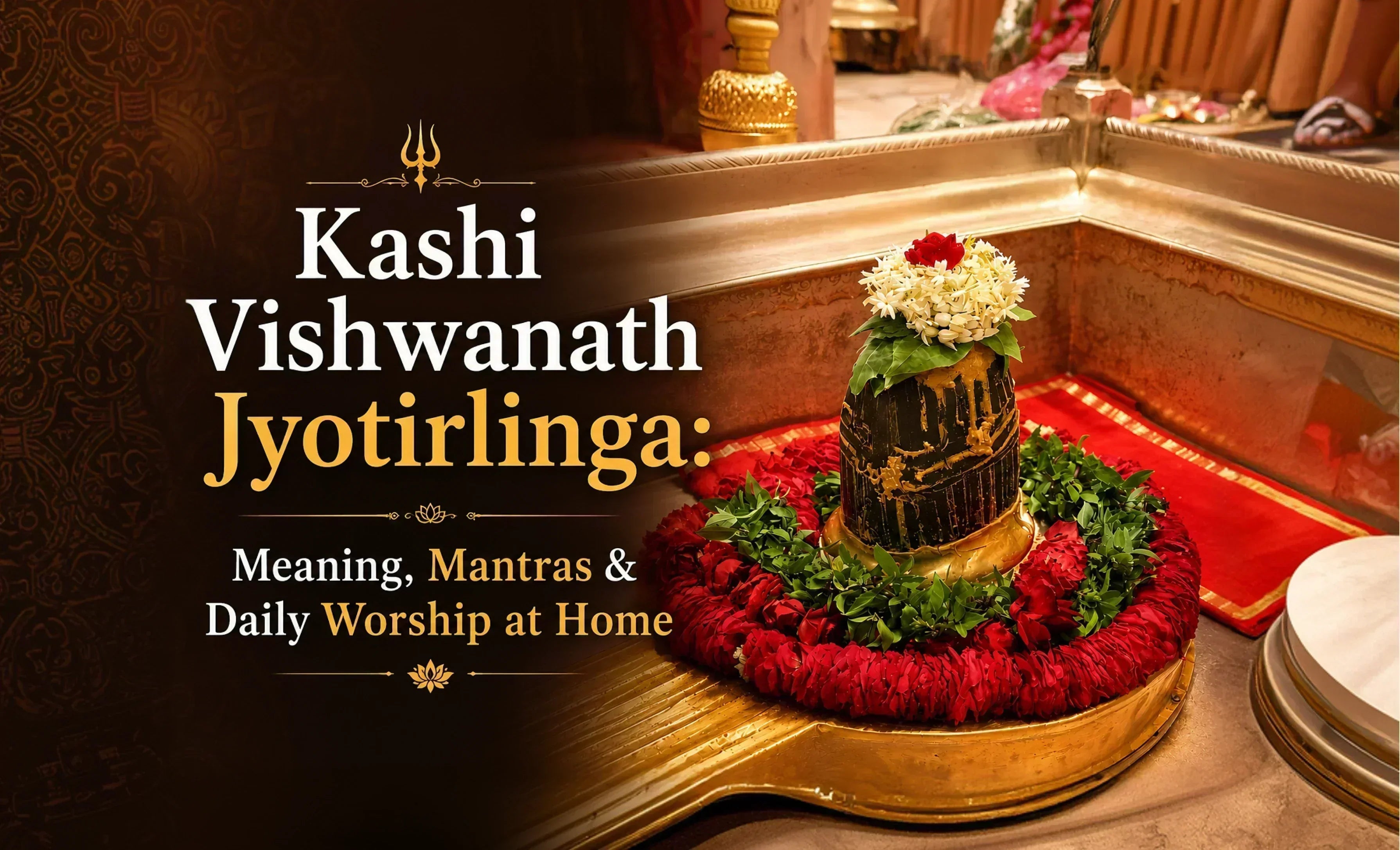
📍 Quick Facts — Kashi Vishwanath Mandir
| Deity | Kashi Vishwanath (Baba Vishwanath) — a Jyotirlinga form of Mahadev |
| Location | Varanasi (Kashi), Uttar Pradesh, India |
| River | Ganga |
| Status | One of the 12 sacred Jyotirlingas of Sanatana Dharma |
| Major Renovation | Kashi Vishwanath Corridor inaugurated December 2021 |
| Primary Texts | Skanda Purana (Kashi Khanda), Shiva Purana |
| Key Mantras | ॐ नमः शिवाय (Om Namah Shivaya) · Mahamrityunjaya Mantra |
| Best Time to Visit | October to March |
| Nearest Airport | Lal Bahadur Shastri International Airport, Varanasi (~25 km) |
There is a city older than memory. Older than the rivers that flow around it. Older than the empires that have risen and fallen along its ghats.
This is Kashi, the City of Light. And at its heart, in a garbh-griha that has witnessed prayers for ten thousand years, stands the Jyotirlinga of Baba Vishwanath — the Lord of the Universe. One of the 12 sacred Jyotirlingas of Sanatana Dharma, regarded by tradition as the foremost among them.
To stand before Kashi Vishwanath, even for a moment, is said to dissolve lifetimes of karma. To live and die in Kashi is, according to the shastras, to receive the taraka mantra directly from Mahadev's own lips at the moment of departure — and to be liberated from the cycle of birth and death itself.
This guide walks you through what Kashi Vishwanath represents, why the Jyotirlinga form is unique, and how you can begin a real Shaiva sadhana at home — whether or not you can make the yatra to Varanasi.
What is the meaning of "Kashi"?
The name Kashi comes from the Sanskrit root kāś (काश्) — "to shine, to illuminate."
Kashi is therefore not merely a place. It is that which illuminates. The geographical embodiment of inner light — the consciousness that Mahadev represents.
In Hindu cosmology, every other tirth bears the burden of pralaya — the great dissolution at the end of each cosmic age. Kashi alone is said to be untouched. The Skanda Purana describes it as resting upon the trident of Mahadev Himself, lifted above the waters of cosmic dissolution.
This is why Kashi is also called Avimukta-kshetra — "the place that is never abandoned" by the Divine.
For you and me, the meaning is unmistakable. Kashi within is the inner consciousness — the prakasha — that no storm of life can extinguish. To worship at Kashi, outwardly or inwardly, is to take refuge in that imperishable light.
Why is Kashi Vishwanath one of the most sacred Jyotirlingas?
The story is preserved across the great shastras.
The Skanda Purana contains the Kashi Khanda — over a hundred chapters glorifying every ghat, every kund, every street of the holy city. The Shiva Purana describes the manifestation of the Jyotirlinga as a column of infinite light — jyoti-svarupa — that even Brahma and Vishnu could not measure.
The famous Shiva Purana account: when Brahma and Vishnu argued over which of them was supreme, Mahadev appeared between them as an endless pillar of light. Vishnu took the form of a boar and descended to find its base. Brahma became a swan and flew up to find its summit. Neither could reach the end.
When they returned in humility, Mahadev revealed Himself in this linga form — the form beyond beginning and beyond end.
At 12 sacred sites across the Indian subcontinent, this Jyotirlinga is said to have manifested in stone. Of these twelve, the one at Kashi is regarded as the foremost — the seat from which Mahadev grants the liberating word to the dying.
"विश्वेश्वरं देवं विश्ववन्द्यं विश्वनाथं विभुं।
विश्वस्वरूपिणं नौमि विश्वस्य परमेश्वरम्॥""I bow to Vishweshwara — the Lord of the universe, worshipped by all, the form of all, the supreme Lord of the cosmos."
What is a Jyotirlinga? (And what does the linga form actually mean?)
The linga is one of the most misunderstood symbols in Sanatana Dharma. Let us be clear about what it is and is not.
The Sanskrit word linga (pindda) simply means "mark" or "sign" — that which points to something beyond itself. It is not, as some have suggested in modern times reference. That reading is a distortion of the tradition, often originating in colonial or polemical interpretation.
The Jyotirlinga is the sign of light. The symbol of Mahadev in His nirguna, nirakara form — the formless absolute, beyond name and shape — appearing in a form just simple enough that the human mind can hold it.
Where deities like Shri Ram Lalla or Shri Krishna invite the heart through their human form, Mahadev at Kashi invites the seeker through the abstraction of the linga. It calls the mind beyond imagery, toward the pure awareness that is His true svarupa.
This is why the Kashi Jyotirlinga has always been the special destination of jnanis — seekers of liberating knowledge.
How to begin Shiva-bhakti at home
For the householder, daily Shaiva worship rests upon a few unchanging pillars. Here they are:
- Om Namah Shivaya — the Panchakshari mantra, the five-syllable invocation that contains the universe.
- The Mahamrityunjaya Mantra — the mantra of victory over death itself.
- Daily Abhishek — the ritual bathing of the linga. The central act of Shaiva worship.
- Bilva-arpana — the offering of bilva leaves, which Mahadev is said to accept above all other offerings.
The Mahamrityunjaya Mantra is one of the most beloved verses in the entire Vedic corpus:
"ॐ त्र्यम्बकं यजामहे सुगन्धिं पुष्टिवर्धनम्।
उर्वारुकमिव बन्धनान् मृत्योर्मुक्षीय मामृतात्॥""We worship the three-eyed One — fragrant, increasing nourishment. Like a ripe cucumber freed from its stem, may we be freed from death — but not from immortality."
This is the mantra of Mahadev's grace. It is chanted in times of illness, in danger, in grief, or simply as a daily offering. The shastras say its consistent japa builds a quiet armour of well-being around the devotee's life.
Here is the simplest daily practice you can begin tomorrow morning:
- Sit quietly each morning before your puja-sthan.
- Chant ॐ नमः शिवाय (Om Namah Shivaya) for a few minutes with attention.
- Offer a single bilva-patra — physically, or mentally — to Mahadev.
- Sit in silence for a moment afterward.
That, done with sincerity, is complete worship.
Bringing Kashi home — The Smart Frame as Sahayak
To stand before Baba Vishwanath in the actual Kashi garbh-griha — to pour Ganga jal over the Jyotirlinga with one's own hands — is the dream of every Shaiva-bhakta. But for most devotees, the realities of life make daily yatra impossible. The heart asks: how do I bring Kashi home?
The traditional answer is Manas Puja — the inner worship described in our companion piece on Manas Puja, where Baba Vishwanath is invoked in the heart's own garbh-griha.
But the beginner faces real difficulties. Three of them, specifically:
- The form (svarupa) — how exactly is the Kashi Jyotirlinga adorned? Most of us have a vague mental picture, not the actual shastra-aligned form.
- The procedure (vidhi) — what is the correct sequence of panchamrit-snana, shuddhodaka-snana, vastra-arpana, bilva-patra?
- The mantras (uccharan) — which shlokas accompany each step of abhishek, and how are they pronounced correctly in Sanskrit?
Without these three, visualisation becomes uncertain and the inner ritual loses its shakti.
This is where our Shri Kashi Vishwanath Portal Frame — 3D AR Edition serves as a complete sahayak to ancient practice.
The frame reveals Baba Vishwanath in His shastra-aligned form — the same Jyotirlinga as worshipped in the Kashi garbh-griha. The AR portal walks you through the correct vidhi of abhishek, in proper sequence — panchamrit-snana, shuddhodaka-snana, vastra-arpana, bilva-patra — with the prescribed mantras chanted in correct Sanskrit pronunciation.
You look into the frame. The form, the procedure, and the sound enter the mind together. You close your eyes — and all three arise within. Shaiva-bhakti finds its inner foundation.
Aaj Ka Darshan — live from the Kashi garbh-griha
After you complete the guided puja and abhishek through the AR portal, the frame transitions to show the Aaj Ka Darshan — the live image of Baba Vishwanath's Jyotirlinga from the actual Kashi garbh-griha on that very day.
The same darshan a yatri standing before the Jyotirlinga at Kashi would receive that morning.
Your home shrine and Kashi are no longer separated by distance. They are joined in real time, every single day.
How to reach Varanasi and Kashi Vishwanath Mandir
If you are planning a yatra, here is the essential information.
- By Air: Lal Bahadur Shastri International Airport, Varanasi — approximately 25 km from the mandir. Direct flights from most major Indian cities and select international destinations.
- By Rail: Varanasi Junction (Cantt) and Banaras railway stations are well-connected to all major Indian cities. Auto-rickshaws and taxis are available to reach the mandir.
- By Road: Varanasi is connected by NH-2 (Grand Trunk Road) and other major highways from Lucknow, Allahabad (Prayagraj), Patna, and Delhi.
- Best Season: October to March — pleasant weather, ideal for the ghat walks and mandir darshan. Avoid May–June (extreme heat) and July–September (monsoon flooding of ghats).
- Darshan Timings: The mandir is generally open from before dawn until late evening, with Mangala Aarti at approximately 2:45–3:00 AM and Shringar Aarti and Sandhya Aarti at scheduled times. The Saptarishi Aarti at Kashi Vishwanath is a particularly revered early-morning seva. Check the official Shri Kashi Vishwanath Mandir website for current timings, as they vary by day and season.
For major Shaiva festivals — Maha Shivaratri (February/March), Shravan Maas (July/August), and Karthik Purnima (November) — book accommodation well in advance. Varanasi swells with pilgrims during these periods.
Featured Smart Frames for Shaiva Sadhana


Teachings of the Saints on Shaiva-bhakti
Adi Shankaracharya — the great philosopher-saint of the 8th century — composed some of the most beloved hymns to Mahadev. His Shiva Manasa Puja Stotram remains the foundational text for inner worship of Mahadev, where every offering is created within the mind itself.
Goswami Tulsidas, though best known as the bhakta of Shri Ram, was equally a worshipper of Mahadev — he taught that Shiva and Ram are not separate, but two faces of the one Divine.
Saint Sundarar, one of the great Tamil Shaiva saints, composed hymns of such love that he is said to have walked through life as Mahadev's intimate friend rather than His devotee.
Across centuries, across languages, across philosophical positions — the form of Mahadev at Kashi has been the same magnet for the seeker's heart.
What to do when the practice feels hard
Let us be honest about this. Shaiva-bhakti is not without difficulty.
The Mahamrityunjaya Mantra is chanted incorrectly. The panchamrit vidhi is performed in the wrong order. The Sanskrit pronunciation of the abhishek mantras is half-remembered. The mind, even during the most beautiful ritual, wanders to tomorrow's worries.
Even the saints acknowledged this. Adi Shankaracharya, in the Shiva Manasa Puja itself, begged Mahadev's forgiveness for the imperfections of his own worship — the mind that strayed, the mantras that faltered, the offerings that fell short.
And Mahadev, the saints teach, accepts the devotee not for the perfection of the ritual, but for the sincerity of the heart.
Still, abhyasa over time refines the practice. For seekers whose vidhi feels uncertain or whose mantras feel half-formed, the Shri Kashi Vishwanath Portal Frame offers a structured path forward — the form to visualise, the vidhi to follow, the mantra to chant — so that nothing in the inner ritual is guessed. The frame teaches. The mind learns. The worship becomes inner.


The eternal light within
The Jyotirlinga at Kashi is the most ancient form of worship in Sanatana Dharma. A column of light that even Brahma and Vishnu could not measure.
It points to a truth that lives beyond all imagery: the Divine is the very light by which we see.
To worship at Kashi, outwardly or inwardly, is not to ask Mahadev for something. It is to remember that the light one is searching for is the light by which one is already searching.
"काशी क्षेत्रे विशालाक्षी विश्वनाथः पतिः शिवः।
तस्मै नमः सदा भक्त्या प्रणतोइहं सदा शिवम्॥""In the kshetra of Kashi dwells Vishalakshi, with Vishwanath the Lord of all as her consort. To Him, the eternally auspicious One, I bow with devotion always."
Common Questions about Kashi Vishwanath
Who is Kashi Vishwanath?
Kashi Vishwanath is Mahadev Himself, in His form as the Lord of Kashi — the city of light. The Jyotirlinga at Kashi Vishwanath Mandir in Varanasi is one of the 12 principal Jyotirlingas of Sanatana Dharma and is regarded as the foremost among them. Devotees believe a single darshan at Kashi dissolves the karma of many lifetimes.
What is a Jyotirlinga?
A Jyotirlinga is a self-manifested form of Mahadev as a column of light (jyoti-svarupa). The Shiva Purana describes the original Jyotirlinga as an endless pillar of light whose beginning Vishnu could not find and whose end Brahma could not reach. At 12 sacred sites across India, this Jyotirlinga is said to have manifested in stone, accessible to human worship. Kashi Vishwanath, Omkareshwar, Somnath, and Mahakaleshwar are among these twelve.
How many Jyotirlingas are there?
There are 12 principal Jyotirlingas of Mahadev across India: Somnath (Gujarat), Mallikarjuna (Andhra Pradesh), Mahakaleshwar (Madhya Pradesh), Omkareshwar (Madhya Pradesh), Kedarnath (Uttarakhand), Bhimashankar (Maharashtra), Kashi Vishwanath (Uttar Pradesh), Trimbakeshwar (Maharashtra), Vaidyanath (Jharkhand), Nageshwar (Gujarat), Rameshwaram (Tamil Nadu), and Grishneshwar (Maharashtra).
What is the Mahamrityunjaya Mantra?
The Mahamrityunjaya Mantra is one of the most beloved Vedic verses, addressed to Mahadev as the Three-Eyed Lord. It is chanted for protection from illness, danger, untimely death, and for spiritual liberation. Its consistent daily japa, traditionally counted on a Rudraksha mala, is said to build a quiet armour of well-being around the devotee's life.
Why is Kashi called the City of Light?
The Sanskrit name Kashi comes from the root kash, meaning "to shine." Kashi is the geographical embodiment of inner light — the consciousness that Mahadev represents. The shastras describe Kashi as resting upon Mahadev's own trident, lifted above the waters of cosmic dissolution — the one tirth that is never abandoned.
Can I worship Kashi Vishwanath at home?
Yes. While yatra to Kashi carries a unique merit, the daily worship of Mahadev in any form — a small linga in the puja-sthan, a printed image, or a Smart Frame — is fully valid and effective. The shastras teach that Mahadev responds first to bhavana (sincere feeling), and that the home shrine, kept with devotion, becomes a true seat of His presence.
How does the Shri Kashi Vishwanath Smart Frame help with daily worship?
The Shri Kashi Vishwanath Portal Frame addresses three things beginners commonly struggle with — what form to visualise, how to perform the abhishek vidhi, and which mantras to chant. Through 3D AR, the frame presents Baba Vishwanath in his shastra-aligned Jyotirlinga form, guides the devotee step by step through the panchamrit-abhishek, and provides the prescribed mantras in correct Sanskrit pronunciation.
What is Aaj Ka Darshan for Kashi Vishwanath?
Aaj Ka Darshan is a feature of Shubh Darshan's Smart Frames that shows the live image of Baba Vishwanath's Jyotirlinga from the actual Kashi garbh-griha on that very day. After the devotee completes the guided puja and abhishek through the AR portal, the frame transitions to show the same darshan a yatri standing before the Jyotirlinga at Kashi would receive that morning — joining the home shrine and the Kashi tirth in real time.
How do I reach Kashi Vishwanath Mandir?
Varanasi is connected by air via Lal Bahadur Shastri International Airport (approximately 25 km from the mandir), by rail via Varanasi Junction (Cantt) and Banaras stations, and by road from all major North Indian cities. The best season for yatra is October to March.
Continue Your Spiritual Journey
If this reflection on Baba Vishwanath has touched something within you, you may also enjoy our companion pieces on Manas Puja — The Hidden Tradition of Mental Worship and Rudraksha Origin — The Shiva Tears Story, both of which deepen the Shaiva sadhana that finds its source at Kashi.


Share:
Tirumala Tirupati Balaji: Sapta Giri, Shri Venkateshwara & Daily Bhakti
Tirumala Tirupati Balaji: Sapta Giri, Shri Venkateshwara & Daily Bhakti