
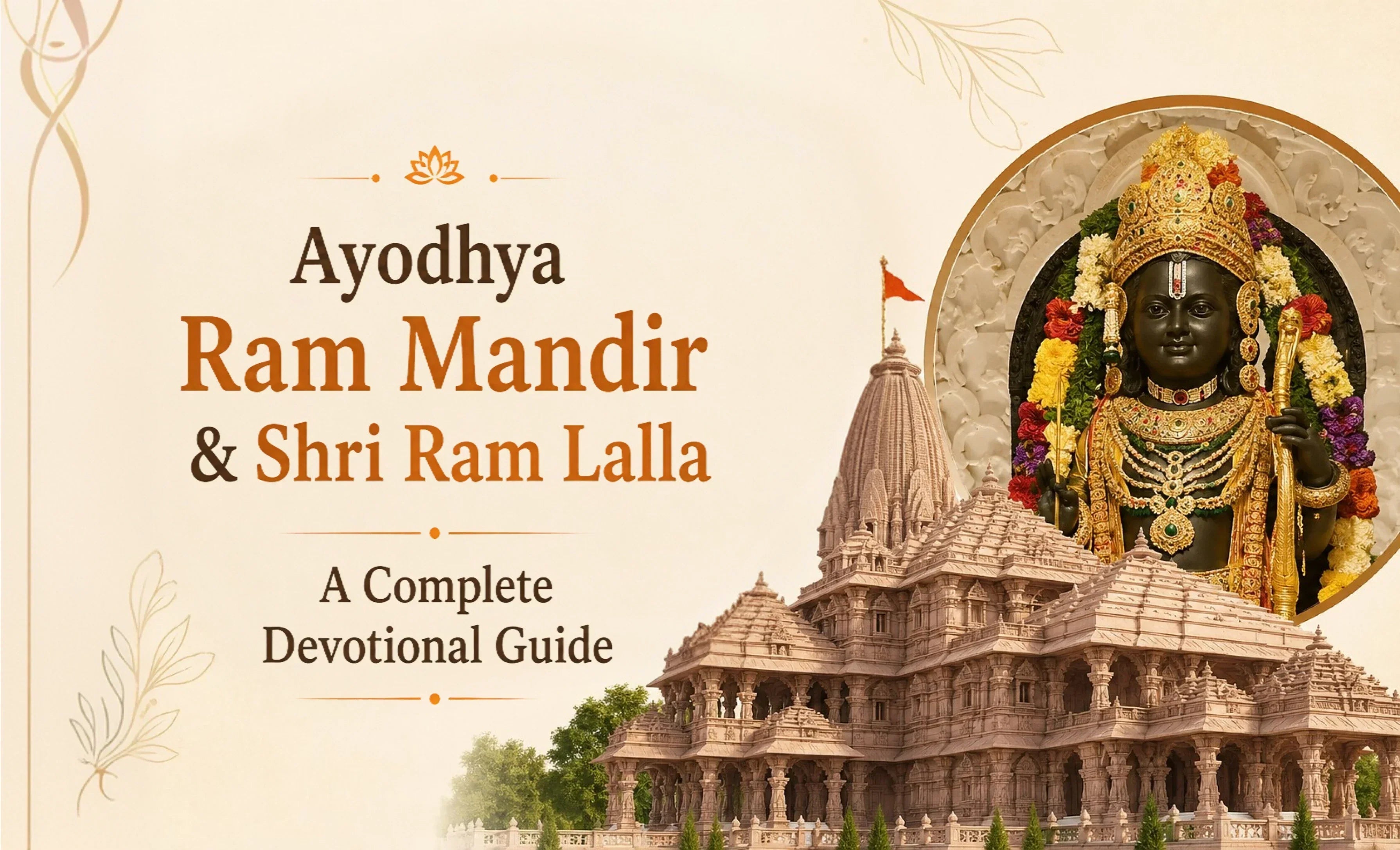
📍 Quick Facts — Ayodhya Ram Mandir & Shri Ram Lalla
| Deity | Shri Ram Lalla — child form (bal-svarupa) of Bhagavan Shri Ram |
| Location | Ayodhya, Uttar Pradesh, India |
| River | Sarayu |
| Pran Pratishtha | 22 January 2024 |
| Architectural Style | Nagara (North Indian) |
| Primary Texts | Valmiki Ramayana, Ramcharitmanas, Adhyatma Ramayana |
| Key Mantra | श्री राम जय राम जय जय राम (Shri Ram Jai Ram Jai Jai Ram) |
| Best Time to Visit | October to March |
| Nearest Airport | Ayodhya (Maharshi Valmiki) International Airport |
In January 2024, after centuries of waiting, the Ayodhya Ram Mandir was consecrated on the banks of the Sarayu. At its garbh-griha sits Shri Ram Lalla — the child form of Bhagavan Shri Ram, the seventh avatara of Bhagavan Vishnu. For millions of devotees across India and the world, this was the answer to a prayer that had been carried in the heart for generations.
If you have ever felt drawn to Ayodhya — whether or not you have made the yatra — this guide is for you. We will walk through who Shri Ram Lalla is, why the new mandir matters, and how you can begin a meaningful daily Ram-bhakti at home. You do not need a Sanskrit education or a guru's initiation to begin. You just need to start.
Who is Shri Ram Lalla?
Shri Ram Lalla is the child form of Bhagavan Shri Ram — eternally five years old, eternally radiant. The murti installed at the Ayodhya Ram Mandir is of this child form.
Across the Bhakti tradition, this is not seen as a "lesser" form. The child form is the form that melts the heart. Before the warrior who breaks the bow at Mithila, before the king who rules from Ayodhya, there is the child who plays in the courtyard of Kausalya Mata. This is the form that allows even the most learned acharya to approach the Divine not with knowledge, but with simple love.
When you stand before Shri Ram Lalla — at Ayodhya, in your home shrine, or in your inner mandir — you are invited to come close. That is the whole teaching.
What is the meaning of "Ayodhya"?
The word Ayodhya means "that which cannot be conquered." It comes from a + yudhya — the place beyond conflict.
Ayodhya is not only a city on the map. It is a state of being. The shastras describe Ayodhya as Bhagavan Vishnu's own sankalpa, manifested upon earth so that human beings — bound by their senses — could behold the formless through a form.
For the devotee, Ayodhya is wherever Shri Ram lives — in the temple, in the chant, and ultimately, in the heart. As Tulsidasji wrote in the Ramcharitmanas:
"राम नाम मनि दीप धरु जीह देहरीं द्वार।
तुलसी भीतर बाहेरहूँ जौं चाहसि उजियार॥""Place the lamp of Ram's name upon the threshold of the tongue — and Tulsi says, light will fill both within and without."
The Story of Ayodhya in Sanatana Dharma
The story of Shri Ram is preserved across the entire span of Sanatana Dharma's literature.
- Valmiki Ramayana — composed by the adi-kavi Maharshi Valmiki himself. The original telling.
- Adhyatma Ramayana — reveals the inner, philosophical meaning of every episode.
- Ramcharitmanas — Goswami Tulsidas's 16th century retelling that brought Shri Ram into every Hindi-speaking household.
- Skanda Purana — contains the Ayodhya Mahatmyam, glorifying every ghat, every kund, every street of the holy city.
The Valmiki Ramayana opens not with a battle or a king, but with a single question about virtue itself:
"कोन्वस्मिन् साम्प्रतं लोके गुणवान् कश्च वीर्यवान्।
धर्मज्ञश्च कृतज्ञश्च सत्यवाक्यो दृढव्रतः॥""Who in this world today is virtuous, mighty, knower of dharma, grateful, true of word, and firm in vow?"
Maharshi Narada answers with a single name — Ram. The entire Ramayana is the unfolding of how a human life can embody those qualities completely.
To meditate on Shri Ram, then, is to meditate upon dharma itself.
How to begin Ram-bhakti at home
Ram-bhakti is one of the simplest and most profound paths in Sanatana Dharma. It rests upon two pillars:
- Ram-nama japa — the loving, continuous repetition of the divine name.
- Ramayana shravana — the regular hearing or recitation of His story.
For Ram-bhaktas, the Taraka Mantra — the mantra that carries the soul across the ocean of samsara — is according to many acharyas simply this:
श्री राम जय राम जय जय राम
Shri Ram Jai Ram Jai Jai Ram
Six syllables. Six. And yet within them, the saints say, is contained the essence of all Vedanta.
Here is the practice in its simplest form, the one you can begin tomorrow morning:
- Sit quietly for five minutes before your home shrine.
- Chant "Shri Ram Jai Ram Jai Jai Ram" with attention — even 108 times on a mala.
- Visualise Shri Ram Lalla seated before you.
- Offer Him a flower — in your hands, or in your mind, with full sincerity.
That is enough. That is a complete puja.
Bringing Ayodhya home — the Smart Frame as sahayak
The yatra to Ayodhya is a once-in-a-lifetime aspiration for many devotees. Distance, time, family responsibilities — life makes daily yatra impossible. And yet the heart asks: how do I bring Ayodhya home?
The traditional answer has always been Manas Puja — the inner worship described in our companion piece on Manas Puja, where the deity is invoked in the heart's own mandir.
But the beginner faces a real difficulty. Three real difficulties, in fact:
- The form (svarupa) — what exactly does Shri Ram Lalla look like? Most of us have a vague mental picture, not the actual shastra-aligned bal-svarupa.
- The procedure (vidhi) — in what sequence should the puja be performed? Avahana, snana, vastra-arpana, naivedya — most beginners do not know the order.
- The mantras (uccharan) — which shlokas accompany each step, and how are they pronounced correctly in Sanskrit?
Without these three, visualisation becomes vague and the inner ritual loses its shakti.
This is where our Shri Ram Lalla Portal Frame — 3D AR Edition serves as a complete sahayak to ancient practice.
The frame reveals Shri Ram Lalla in his shastra-aligned form — the same divya bal-svarupa as installed in the Ayodhya garbh-griha. The AR portal walks you through the correct vidhi of puja and abhishek, step by step, with the prescribed mantras chanted in correct Sanskrit pronunciation.
You look into the frame. The form, the procedure, and the sound enter the mind together. You close your eyes — and all three arise within. Ram-bhakti finds its inner ground.
Aaj Ka Darshan — live from the Ayodhya garbh-griha
This is the feature we are most proud of, and it is unique to Shubh Darshan Smart Frames.
After you complete the guided puja and abhishek through the AR portal, the frame transitions to show the Aaj Ka Darshan — the same live image of Shri Ram Lalla from the actual Ayodhya garbh-griha that a yatri standing before Him in Ayodhya would receive on that very day.
Your home shrine and the Ayodhya tirth are no longer separated by distance. They are joined in real time, every single morning.
How to reach Ayodhya
If you are planning a yatra, here is what you need to know.
- By Air: Ayodhya Maharshi Valmiki International Airport (opened January 2024) is the most direct route. Lucknow International Airport (about 135 km away) is the secondary option with more frequent connections.
- By Rail: Ayodhya Junction connects to most major North Indian cities. Faizabad Junction (about 6 km away) is the larger alternate station.
- By Road: Ayodhya is well-connected by road from Lucknow, Varanasi, Allahabad (Prayagraj), and Gorakhpur. Buses and taxis are widely available.
- Best Season: October to March. Summers (May–June) are harsh; monsoon (July–September) can disrupt travel.
- Darshan Timing: Check the official Shri Ram Janmabhoomi Teerth Kshetra Trust website for current timings, which vary by season and special days.
For a yatra during major festivals — Ram Navami (March/April), Diwali (October/November), or the Pran Pratishtha anniversary (January) — book accommodation well in advance. Ayodhya now sees several million visitors during peak periods.
Featured Smart Frames for Ram-Bhakti Sadhana


Teachings of the Saints on Ram-bhakti
Across centuries, different paths, different languages — one name has held them all.
Goswami Tulsidas said that all paths are made easier by Ram-nama. Even where japa and dhyana feel difficult, the simple repetition of the name carries the soul across.
Sant Kabir declared that the inner Ram and the outer Ram are not two. The seeker who finds Ram within finds Ram everywhere.
Saint Tyagaraja composed over 700 kirtanas in the Carnatic tradition, all addressed to Shri Ram. His entire life was Ram-nama made into music.
If you are wondering whether your simple daily practice "counts" — listen to these voices. They have walked the path. The answer is yes.
The challenges (and what to do about them)
Ram-bhakti, for all its simplicity, is not without difficulty. Let us be honest about this.
The mind wanders during japa. The visualisation of Shri Ram Lalla feels unclear. The vidhi of daily puja is half-remembered. The mantras are mispronounced, or forgotten, or were never properly learned in the first place.
Even the greatest devotees acknowledged this. Tulsidasji wrote that the mind is like a chanchal vanar — a restless monkey — and only abhyasa over time can train it to rest upon the divine form.
The point is not to wait until the mind is perfect before beginning. The point is to begin.
If the visualisation feels uncertain, abhyasa starts with a structured darshan. The Shri Ram Lalla Portal Frame walks you through every step — the form to visualise, the vidhi to follow, the mantra to chant — so nothing in the inner ritual is guessed. The frame teaches. The mind learns. The worship becomes inner.


Ayodhya is wherever Ram lives
The new Ayodhya Ram Mandir is a gift to our generation — a long-awaited fulfilment of centuries of waiting.
But the deepest truth of Ram-bhakti is also the simplest: Bhagavan Shri Ram does not live only in Ayodhya. He lives wherever His name is chanted with love.
The Ayodhya in stone is for the body to visit. The Ayodhya in the heart is for the soul to dwell in.
And between these two, in our own moment of history, stands a quiet new possibility: the home shrine joined to the Ayodhya garbh-griha in real time, every single day — so that the rhythm of the actual tirth becomes the rhythm of the home, and the devotee never feels far.
"राम राम कहु राम राम कहु राम राम कहु भाई।
राम नाम सम कुछु न जग में, तुलसी कहत बजाई॥""Say Ram, say Ram, say Ram, O brother — nothing in this world is equal to the name of Ram, says Tulsi, beating his hand to it."
Common Questions about Ayodhya & Shri Ram Lalla
Who is Shri Ram Lalla?
Shri Ram Lalla is the child form (bal-svarupa) of Bhagavan Shri Ram, the seventh avatara of Bhagavan Vishnu. The murti installed at the Ayodhya Ram Mandir's garbh-griha is of this child form — eternally five years old, eternally inviting devotees to come close.
When was the new Ayodhya Ram Mandir consecrated?
The Pran Pratishtha ceremony was held on 22 January 2024. The temple is built in the Nagara architectural style on the site of Shri Ram's janma-bhumi (birthplace) in Ayodhya, Uttar Pradesh.
Why is Ayodhya considered the most sacred city for Ram-bhakti?
Ayodhya is the janma-bhumi of Bhagavan Shri Ram — the place where He took human birth in the Treta Yuga. The shastras describe Ayodhya as Bhagavan Vishnu's own sankalpa, manifested upon earth as a living tirth. Devotees believe that even a single yatra to Ayodhya carries spiritual merit beyond measure.
What is the simplest way to begin Ram-bhakti at home?
Begin with daily Ram-nama japa — chant "Shri Ram Jai Ram Jai Jai Ram" for five to ten minutes each morning. Add a regular hearing or reading of the Ramcharitmanas, even one chaupai a day. These two practices, kept up with sincerity, form the complete foundation of household Ram-bhakti.
What is the Taraka Mantra?
The Taraka Mantra is the mantra that "carries the soul across" the ocean of samsara. For Ram-bhaktas, the most widely accepted Taraka Mantra is the six-syllable "Shri Ram Jai Ram Jai Jai Ram." Acharyas across traditions have testified that its consistent japa purifies the mind and reveals the Divine within.
Can I worship Shri Ram Lalla at home without visiting Ayodhya?
Yes. The shastras and the saints have always taught that the Divine responds first to bhavana — sincere feeling — and only secondarily to physical location. You can establish Shri Ram Lalla in your home shrine and offer daily puja with full devotion. For those who wish to keep a living connection with the Ayodhya garbh-griha itself, modern aids now make this possible in ways earlier generations could not have imagined.
How does the Shri Ram Lalla Smart Frame help with daily worship?
The Shri Ram Lalla Portal Frame addresses the three things beginners commonly struggle with — what form to visualise, how to perform the vidhi, and which mantras to chant. Through 3D AR, the frame presents Shri Ram Lalla in his shastra-aligned bal-svarupa, guides the devotee step by step through the prescribed puja and abhishek vidhi, and provides the proper mantras in correct Sanskrit pronunciation.
What is Aaj Ka Darshan?
Aaj Ka Darshan is a feature of Shubh Darshan's Smart Frames that shows the live image of Shri Ram Lalla from the actual Ayodhya garbh-griha on that very day. After the devotee completes the guided puja and abhishek through the AR portal, the frame transitions to show the same darshan a yatri standing before Shri Ram Lalla in Ayodhya would receive that morning — joining the home shrine and the Ayodhya tirth in real time.
How do I reach Ayodhya?
The fastest route is by air via Ayodhya Maharshi Valmiki International Airport (opened January 2024), with Lucknow International Airport (about 135 km away) as the secondary option. Ayodhya Junction connects to most major North Indian cities by rail. The best season for yatra is October to March.
Continue Your Spiritual Journey
If this reflection on Shri Ram Lalla has touched something within you, you may also enjoy our companion piece on Manas Puja — The Hidden Tradition of Mental Worship, which explores the inner sadhana that turns every darshan into a doorway to the heart.


Share:
Tirumala Tirupati Balaji: Sapta Giri, Shri Venkateshwara & Daily Bhakti