
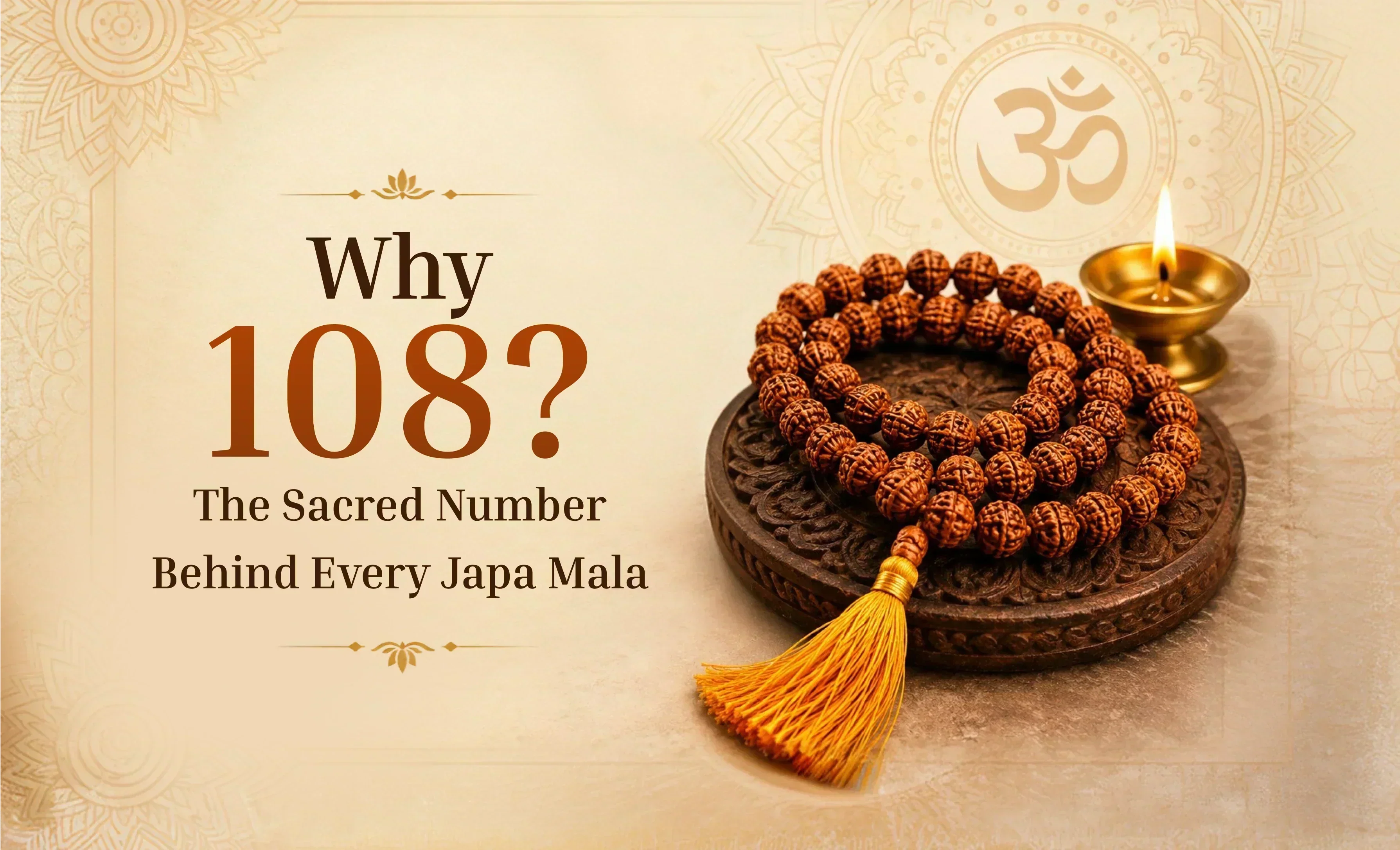
Have you ever picked up a Japa Mala and counted the beads? Every single mala — whether it's a Rudraksha Mala, a Karungali Mala, or a simple tulsi mala — has exactly 108 beads. Not 100. Not 110. Always 108.
This is not a coincidence. This is not a tradition someone made up randomly. The number 108 is one of the most sacred, most studied, and most deeply meaningful numbers in Hindu, Buddhist, and Vedic tradition. And once you understand why, you will never look at your mala the same way again.
The Universe Is Hidden Inside This Number
Let's start with something that will genuinely surprise you.
The distance between the Sun and the Earth is approximately 108 times the Sun's diameter. The distance between the Moon and the Earth is approximately 108 times the Moon's diameter. The diameter of the Sun is approximately 108 times the diameter of the Earth.
Our ancient Vedic scholars — thousands of years before modern astronomy — had already encoded this cosmic relationship into the 108 beads of the Japa Mala. When you hold a mala in your hands and chant, you are literally holding the geometry of the universe between your fingers.
What the Vedas and Shastras Say
In Vedic astrology, there are 12 rashis (zodiac signs) and 9 grahas (planets). Multiply them: 12 × 9 = 108.
The Vedas speak of 108 Upanishads — the foundational texts of Hindu philosophy. There are 108 names of Lord Shiva, 108 names of Goddess Lakshmi, and 108 names of Lord Vishnu — called the Ashtottara Shatanamavali. Each name is a different form of the divine, and chanting all 108 is considered a complete offering.
In the human body, there are believed to be 108 marma points — sacred energy points in Ayurveda, similar to the concept of pressure points. These are the intersections where body, mind, and spirit connect. Some texts also say there are 108 nadis (energy channels) that converge at the heart chakra.
The Science of Japa — Why Repetition Matters
Japa means repetition of a mantra or divine name. But why 108 times specifically?
When you chant a mantra 108 times, you are completing what the ancient masters called a "purn chakra" — a full cycle. Think of it like a complete breath of the universe. One round of 108 is not just chanting — it is tuning your entire nervous system, your breath, and your focus to a single point of awareness.
Modern neuroscience actually supports this. Repetitive chanting at a slow, steady pace activates the parasympathetic nervous system, reduces cortisol (the stress hormone), and creates a state of deep calm. 108 repetitions, taking roughly 10–15 minutes, is the exact duration that researchers have found most effective for inducing a meditative state.
The mala is not just a counting tool. It keeps your hands engaged so your mind doesn't wander. It creates a physical loop — bead by bead — that mirrors the inner loop of focus you are building.
The Guru Bead: The 109th Bead
You may have noticed that most malas have one slightly different bead — larger, or differently shaped — sitting at the top. This is called the Sumeru bead or the Guru bead.
You never cross this bead during Japa. When you complete 108 repetitions and reach the Guru bead, you pause, reverse direction, and begin again. This bead represents your guru, your lineage, and the divine energy from which all mantras flow. Crossing it without reverence is considered disrespectful to the practice.
It is also a marker of completion — a moment of gratitude before you begin again.
Different Malas, Different Purposes
Not all malas are made the same. The material of the mala matters deeply in Vedic tradition, because different materials carry different energies and connect to different deities and purposes.
Rudraksha Mala
Made from the sacred tears of Lord Shiva. Rudraksha beads are considered the most powerful for removing obstacles, calming the mind, and invoking the blessings of Mahadev. They are especially powerful for Japa of Shiva mantras, Gayatri mantra, and Maha Mrityunjaya mantra.
Karungali (Ebony) Mala
Karungali or black ebony wood is deeply connected to Lord Murugan and Saturn (Shani Dev). It is considered a powerful protector, removing negative energy, black magic, and Nazar (evil eye). Wearing or chanting on a Karungali mala is especially beneficial for those facing Shani Sade Sati, Rahu-Ketu doshas, or constant obstacles in life.
Rudraksha-Karungali Combo Mala
This combines the divine energy of Shiva's tears with the protective power of black ebony. The combination creates a shield of spiritual energy — protection from outside negativity while building inner strength and devotion simultaneously.
The material of your mala is not decoration. It is intention made tangible.


How to Use Your Japa Mala the Right Way
Using a mala correctly multiplies its power many times over. Here is the traditional method:
- Hold it in your right hand. Loop the mala over your middle finger. Use your thumb to move each bead toward you as you chant. Never use your index finger to touch the beads — in Vedic tradition, the index finger represents ego, and ego has no place in prayer.
- Start at the bead just after the Guru bead. Move bead by bead, chanting your mantra once per bead.
- When you reach the Guru bead, do not cross it. Reverse direction and begin your next round.
- Keep the mala covered. Many practitioners keep their mala in a small cloth bag called a gomukhi while doing Japa. This maintains the energy and keeps it private.
- Chant with intention. A mala chanted absentmindedly is just counting. A mala chanted with full awareness is a prayer that moves through every bead and into the universe.
Why "Kashi Siddh" Makes All the Difference
You may have seen the term Kashi Siddh on some malas and wondered what it means.
Kashi the ancient name for Varanasi is considered the spiritual capital of the world in Hindu tradition. It is the city of Lord Shiva himself. A Kashi Siddh mala is one that has been energized and consecrated through specific Vedic rituals performed in Kashi, by trained pandits using precise mantras, in an energy that thousands of years of devotion have made extraordinarily powerful.
It is the difference between a mala that is merely a string of beads and one that is already awake, already vibrating with divine energy before it even reaches your hands.
When you begin Japa on a Kashi Siddh mala, you are not starting from zero. You are continuing a prayer that has already been begun on your behalf.


This Is Why We Do What We Do at Shubh Darshan
At Shubh Darshan, every mala we offer — from our Karungali Mala 8mm to our Rudraksha-Karungali Combo Mala to our Rudraksha Mala German Silver (54+1 Beads) — is Kashi Siddh and certified.
Each mala comes in a proper gift box with a certification card because we believe you deserve to know exactly what you are bringing into your spiritual practice. We don't sell beads. We offer tools that have been prepared with the same care and reverence that your practice deserves.
The 108 beads in your mala are not just beads. They are the Sun, the Moon, the planets, the chakras, the names of God, and the geometry of the universe — all held together by one thread of intention.
All you have to do is pick it up and begin.
Frequently Asked Questions
Q: Can I use any mala for any mantra?
A: While any mala can technically be used for any mantra, matching the mala material to your intention and deity makes the practice significantly more powerful. Rudraksha for Shiva mantras, Karungali for protection and Murugan mantras — these combinations have been used for centuries for good reason.
Q: How many rounds of 108 should I do daily?
A: Even one round (108 repetitions) daily is highly effective. Three rounds is considered a strong practice. Consistency matters far more than quantity — a daily practice of one mala round is better than seven rounds once a week.
Q: Can women use a Japa Mala?
A: Absolutely. There is no gender restriction on using a Japa Mala. Women have been practitioners of Japa across all traditions throughout history.
Q: How do I know if my mala has lost its energy?
A: If beads break or the mala feels heavy or dull, it may need cleansing. Place it in sunlight for an hour, or keep it near a Shiva lingam or in a temple for a day. A Kashi Siddh mala, however, holds its energy much longer than an unconsecrated one.
Q: What is the best time to do Japa?
A: Brahma Muhurta — roughly 4 AM to 6 AM — is considered the most powerful time. But any consistent time that you can maintain daily will work. The best time is the time you will actually do it.
Explore our collection of Kashi Siddh & Certified Malas at Shubh Darshan — crafted with devotion, certified with care, and delivered to your door.


Share:
The Power of Om (ॐ): Origin, Meaning, and Why It Anchors Every Mantra