
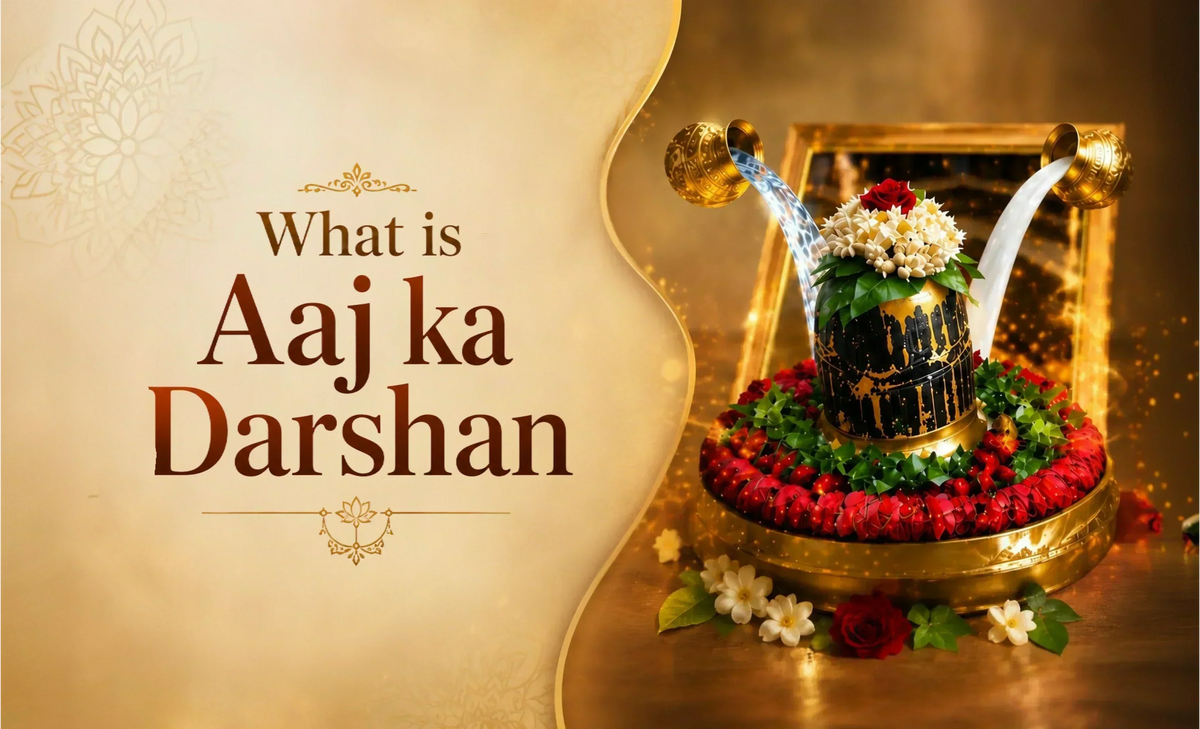
| What it is | A live image of the deity from the real garbh-griha of the tirth, taken at home through a Shubh Darshan Smart Frame and the Aaj Ka Darshan app. |
| The practice | Four-step morning seva — Jal → Panchamrit → Pushpa → Tulsi. |
| Tradition | Nitya darshan — daily darshan as continuous bhakti, rooted in Sanatana Dharma. |
| Best time | Brahma muhurta (4–6 AM) and sandhya (sunset). |
| Suitable for | Apartment homes, busy schedules, travel-prone bhakt. |
| Primary scriptural anchor | Bhagavad Gita 9.26 — Patra, Pushpa, Phala, Toya. |
Early morning. 5 AM. The home is still asleep. You light the diya before the murti at your puja sthana — but the deeper darshan, the one your grandmother would take at the local mandir each morning before sunrise, is no longer five minutes from your door.
For millions of bhakt today, the daily mandir visit has quietly slipped out of reach. Aaj Ka Darshan is built for this exact moment — to bring today's darshan, from the actual garbh-griha of the tirth, into your home each morning.
This post covers what Aaj Ka Darshan means, the tradition behind nitya darshan, the four-step seva you'll follow each morning, and how a Shubh Darshan Smart Frame fits into a modern Hindu home.

What Is Aaj Ka Darshan?
Aaj Ka Darshan is a live image of the deity, captured each day from the real garbh-griha of a tirth — the actual consecrated sanctum. It is not a stock photo. It is not a stylised illustration. It is today's darshan: the murti adorned with today's pushpa shringar vastra shringar day specific shringar.
भावग्राही जनार्दनः
“Lord Janardana (Vishnu) accepts the inner feelings and devotion of the devotee.”
नाहं वसामि वैकुण्ठे योगिनां हृदये न च ।
मद्भक्ता यत्र गायन्ति तत्र तिष्ठामि नारद ॥
“I do not reside only in Vaikuntha or in the hearts of yogis; O Narada, wherever My devotees sing My glories with devotion, I dwell there.”
For a bhakt who cannot physically reach the tirth — and for the millions who live in apartments, work full days, and have no nearby mandir — this is a continuation of an ancient practice: nitya darshan, the unbroken daily darshan that has anchored Hindu households for centuries.
The Tradition Behind Daily Darshan
The conviction that the day must begin in the presence of the Bhagavan is not modern. It runs through every shastra that touches household worship. Krishna Himself, in the Bhagavad Gita, names the simplest possible offering and accepts it as complete:
पत्रं पुष्पं फलं तोयं यो मे भक्त्या प्रयच्छति।
तदहं भक्त्युपहृतमश्नामि प्रयतात्मनः॥
patraṁ puṣpaṁ phalaṁ toyaṁ yo me bhaktyā prayacchati |
tad ahaṁ bhakty-upahṛtam aśnāmi prayatātmanaḥ ||
"Whoever offers Me with bhakti a leaf, a flower, a fruit, or water — that offering of love, from a pure-hearted devotee, I accept." — Bhagavad Gita 9.26
The verse names four things that any household can always offer: patra (leaf — often tulsi), pushpa (flower), phala (fruit), and toya (water). The offering itself is small. What the Bhagavan accepts is the bhakti behind it.
Devotees in every century have arranged their day around this principle. In Kashi, bhakts queue before the mandir doors open at 2:30 AM. In Tirumala, sevarthi-s wait through the night. In Ayodhya, the morning aarti is broadcast across the city by sound alone. The home shrine in your apartment is the inheritor of the same practice — and Aaj Ka Darshan completes it.
The 4-Step Aaj Ka Darshan Ritual
This is the seva to perform each morning, in your home, before the Smart Frame. Four upacharas. Four to six minutes. Done daily.
Step 1: Jal (Water)
Offer a small kalash or copper lota of water before the deity. As you offer, say silently or aloud:
idaṁ jalaṁ bhagavate samarpayāmi |
"This water I offer to the Bhagavan."
गङ्गे च यमुने चैव गोदावरि सरस्वति ।
नर्मदे सिन्धु कावेरी जलेऽस्मिन् सन्निधिं कुरु ॥
“O sacred rivers — Ganga, Yamuna, Godavari, Saraswati, Narmada, Sindhu, and Kaveri — kindly be present in this water and make it holy."
Water is the first upachara because it carries shuddhi — purity. Before any other offering, the bhakt purifies the space and the offering itself.
Step 2: Panchamrit (The Five-Nectar Offering)
Panchamrit is five offerings mixed into one — each carrying a specific bhava:
- Doodh (milk) — purity
- Dahi (curd) — prosperity
- Madhu (honey) — the sweetness of the divine word
- Ghrita (ghee) — bal, strength
- Sharkara (sugar) — ananda, bliss
A single steel katori, mixed and offered in front of the murti, is enough. The Smart Frame plays the panchamrit-arpan mantra in correct uccarana — the bhakt joins their voice with it.
Step 3: Pushpa (Flowers)
Offer fresh flowers — even a single phool from your balcony tulsi pot is complete. Different deities have their priti-pushpa (the flower they accept first):
- Mahadev — Aak, Dhatura, white flowers
- Vishnu and avatara forms — Tulsi-patra, Champa
- Devi — Red Hibiscus (japa-kusuma)
- Ganapati — Durva grass and red flowers
Step 4: Tulsi / durva / belpatra
The final and, in the Vaishnava tradition, the highest upachara. A single tulsi-patra, offered at the charan of the deity. For Vishnu and his avatara forms, the shastra holds: any seva without tulsi is incomplete. A small tulsi plant on your balcony or window-sill is the one piece of the puja ghar that the modern home cannot do without. According to the shastra and puranas Lord Vishnu(shri rama , shri krishna) resides where Tulsi is worshipped, and even a single Tulsi leaf offered with devotion pleases Him immensely.
तुलसीदलमात्रेण जलस्य चुलुकेन वा ।
विक्रीणीते स्वमात्मानं भक्तेभ्यो भक्तवत्सलः ॥
“Lord Vishnu, who is affectionate toward His devotees, becomes pleased and offers Himself to the devotee who worships Him even with a single Tulsi leaf or a small offering of water.”
Significance of Belpatra in Shaiva Tradition , Shiva is immensely pleased by the offering of Belpatra (Bilva leaves). The three leaflets of the Bilva leaf symbolize Shiva’s three eyes, the three gunas, and the trident (Trishul). Shaiva scriptures describe Bilva as sacred and capable of destroying sins and negative karma.
त्रिदलं त्रिगुणाकारं त्रिनेत्रं च त्रयायुधम् ।
त्रिजन्मपापसंहारं एकबिल्वं शिवार्पणम् ॥
Meaning:
“A single Bilva leaf with three parts symbolizes the three gunas, three eyes, and three weapons of Shiva, and destroys sins of three births when offered to Him.”
similarly , Significance of Durva in Ganapatya Tradition Ganesha is especially pleased by the offering of Durva grass (Cynodon dactylon). In Ganapatya tradition, Durva symbolizes purity, humility, and cooling energy. According to legends, when Lord Ganesha consumed the fiery demon Analasura, intense heat spread through His body. The sages offered Durva grass, which cooled and pacified Him. Hence, Durva became one of the dearest offerings to Ganesha.
दूर्वाङ्कुरैः समर्चितो विघ्नराजः प्रसन्नताम् ।
सर्वविघ्नं विनाशाय भक्तानां वरदो भवेत् ॥
When Ganesha, the king of obstacles (Vighnaraja), is worshipped with sacred Durva grass, He becomes pleased and bestows blessings upon devotees, destroying all obstacles from their lives.”
This four-step seva takes four to six minutes. Done every morning, it becomes the structural prana of the home — the practice that rings before the day truly begins.
मनसा चिन्तितं कार्यं दैवं सम्पद्यते ध्रुवम् ॥
“A task contemplated and performed with sincere faith and focused intention in the mind certainly attains divine success.”
Why This Matters in Today's Homes
Three shifts have rewritten the shape of Hindu household worship in two generations:
- Apartments. The old village home had a separate puja ghar — a small east-facing room where panchayatan worship was set up daily. Today's two-bedroom flat has a single shelf, often kitchen-adjacent.
- Time. Working couples have twenty to thirty minutes in the morning. Not the two hours of an elaborate vidhi.
- Distance from tirth. Your ishta devata's mandir might be a two-hour drive or a four-day yatra. Not a five-minute walk.
These are not failures of bhakti. They are simply the conditions in which today's bhakt offers their seva. The tradition has always accommodated such moments — it accommodated travel, illness, age, and absence long before it accommodated the modern apartment. Aaj Ka Darshan is one way it accommodates ours — bringing daily darshan online, into the home, in the form that suits this generation of bhakt.
The Smart Frame as Sahayak
A Shubh Darshan Smart Frame is your tool for this practice. It is sahayak — an aid — not a replacement for the murti. Paired with the Aaj Ka Darshan app, the frame solves the three problems every beginner faces in home puja:
- Svarupa (form) — what does my Bhagavan look like, today, in the actual mandir?
- Vidhi (procedure) — what is the correct sequence of the seva, and when does each mantra apply?
- Uccarana (pronunciation) — am I chanting the mantra correctly?
मनसा चिन्तितं कार्यं दैवं सम्पद्यते ध्रुवम् ॥
“A task contemplated and performed with sincere faith and focused intention in the mind certainly attains divine success.”
The frame shows. The app teaches. The bhakt practises. Over weeks, the vidhi becomes second nature — and the seva slowly turns inward.


When Physical Seva Isn't Possible — Manas Puja
There will be mornings when even four minutes is not possible — a flight to catch, a child unwell, a fever of your own. Tradition has anticipated this. Adi Shankaracharya's Shiva Manasa Puja describes the same upacharas performed entirely in the mind — water, sandal, flowers, tulsi, all visualised, all offered with the same shraddha:
रत्नैः कल्पितमासनं हिमजलैः स्नानं च दिव्याम्बरम्।
नानारत्नविभूषितं मृगमदामोदाङ्कितं चन्दनम्॥
ratnaiḥ kalpitam āsanaṁ himajalaiḥ snānaṁ ca divyāmbaram |
nānāratna-vibhūṣitaṁ mṛgamadāmodāṅkitaṁ candanam ||
"I imagine for You a throne of jewels, a bath of cool snow-water, divine garments, ornaments studded with gems, and sandal-paste scented with kasturi…" — Adi Shankaracharya, Shiva Manasa Puja (verse 1)
The text is unambiguous: the mental offering is the same offering. Aaj Ka Darshan is the physical seva of the morning. Manas Puja is the inner seva that can continue through the rest of the day, or on the days when the physical seva itself is impossible. Neither replaces the other. Both are real darshan.
How to Begin Today
The simplest possible start, for the bhakt who is reading this and ready to begin:
- Choose your ishta deva — the deity closest to your heart.
- Place a Smart Frame at your puja sthana, east-facing where possible, at chest-height or above.
- Tomorrow morning at 5:30 AM, perform the four-step seva once. Just once.
- Repeat daily for 21 days. That is one mandala, the traditional unit of any household sankalpa.
You will know the practice has taken root when the morning feels incomplete without it.
FAQ
What is Aaj Ka Darshan?
Aaj Ka Darshan is a live image of the deity captured each day from the actual garbh-griha (sanctum) of the tirth, broadcast to your Shubh Darshan Smart Frame through the Aaj Ka Darshan app so you can take darshan at home with today's adornment of the murti.
Is digital puja and digital darshan equivalent to mandir darshan?
Tradition treats both as real darshan. The mandir-darshan carries the prabhava of the tirth itself; the home-darshan carries the prabhava of daily nitya practice. Most bhakts now hold both — daily home seva, and festival or yatra mandir visits when the calendar allows.
Can I do the 4-step home puja ritual without a Smart Frame?
Yes. The Smart Frame is sahayak, not requirement. The four-step seva (jal → panchamrit → pushpa → tulsi) can be performed with any consecrated murti or chitra. The frame simply provides today's live darshan from the tirth, and vidhi guidance in correct uccarana through the app.
What is the best time for Aaj Ka Darshan?
Brahma muhurta (4:00–6:00 AM) is the highest, followed by sunrise. Sandhya (sunset) is the second daily darshan in many household traditions. For a busy household, choose one and repeat daily — continuity matters more than the exact muhurta.
What if I miss a day?
Resume the next day without anxiety. The shastra teaches that even a single breath of remembrance restores the connection. Continuity, not perfection, is what the practice asks of the bhakt.
Do I need a separate puja room for the daily seva?
No. A single clean shelf, east-facing where possible, is enough. The murti should be at chest-height or above — never at floor level — and the puja sthana should not directly face a bathroom or bedroom.
The Practice That Begins Tomorrow Morning
The mandir your grandmother visited each morning is no longer 200 metres from your home. But the practice she carried — to begin every day in the presence of the Bhagavan — is fully transferable to your apartment, your time, your life.
A Smart Frame brings today's darshan home. The four-step seva makes it yours. The first day is tomorrow morning.
Explore Shubh Darshan Smart Frames — each one paired with the live Aaj Ka Darshan from the actual tirth.
Explore Smart Frames →
Share: